

11 Stand Out Reasons Caesar Guerini Shotguns Rule the Field & Clay Range in 2025
When an upland hunter or competitive clay shooter starts to talk about “the perfect Italian over‑under,” Caesar Guerini almost always enters the conversation within the first few sentences.
Founded in 2002 by brothers Giorgio and Antonio Guerini in the storied arms‑making town of Brescia, the company has spent just two decades vaulting from an ambitious newcomer to a serious rival of century‑old marques such as Beretta, Perazzi, and Rizzini. The recipe? Twenty‑first‑century engineering married to old‑world hand‑finishing, an obsessive focus on stock fit, and a willingness to listen to American shooters.
Whether you’re walking behind a pointing dog in South Dakota or grinding away at a 400‑target Sporting‑Clays marathon, Guerini shotguns have earned a reputation for pointing naturally, soaking up recoil, and surviving round counts that would send lesser guns back to the gunsmith. Below are eleven specific reasons field and clay shooters alike keep reaching for Caesar Guerini—and why your next shotgun might carry the winged‑lion crest.
A Quick History Lesson: From Brescia to the Winner’s Podium
While the Guerini family can trace its gun‑making roots back to the 19th century, the modern company was born at the 2002 IWA show in Nuremberg. Giorgio and Antonio’s goal was audacious: craft an over‑under that blended the shootability of a Perazzi with the affordability of a Beretta 686, then back it with concierge‑level service. Early models like the Ellis and Essex turned heads, but the breakthrough came in 2006 when the Summit Sporting arrived on U.S. shores—purpose‑built for American clays. By 2010, Guerini guns were racking up NSCA titles, and the company partnered with Connecticut Shotgun to open a full‑service U.S. headquarters in Cambridge, Maryland. That 30‑employee facility now stocks every spare part down to firing‑pin bushings and employs master stock‑fitters trained in Brescia. The journey from ambitious start‑up to establishment contender took barely twenty years—lightning speed in an industry where pedigrees are often measured in centuries.
1. Bespoke Italian Craftsmanship Meets CNC Precision
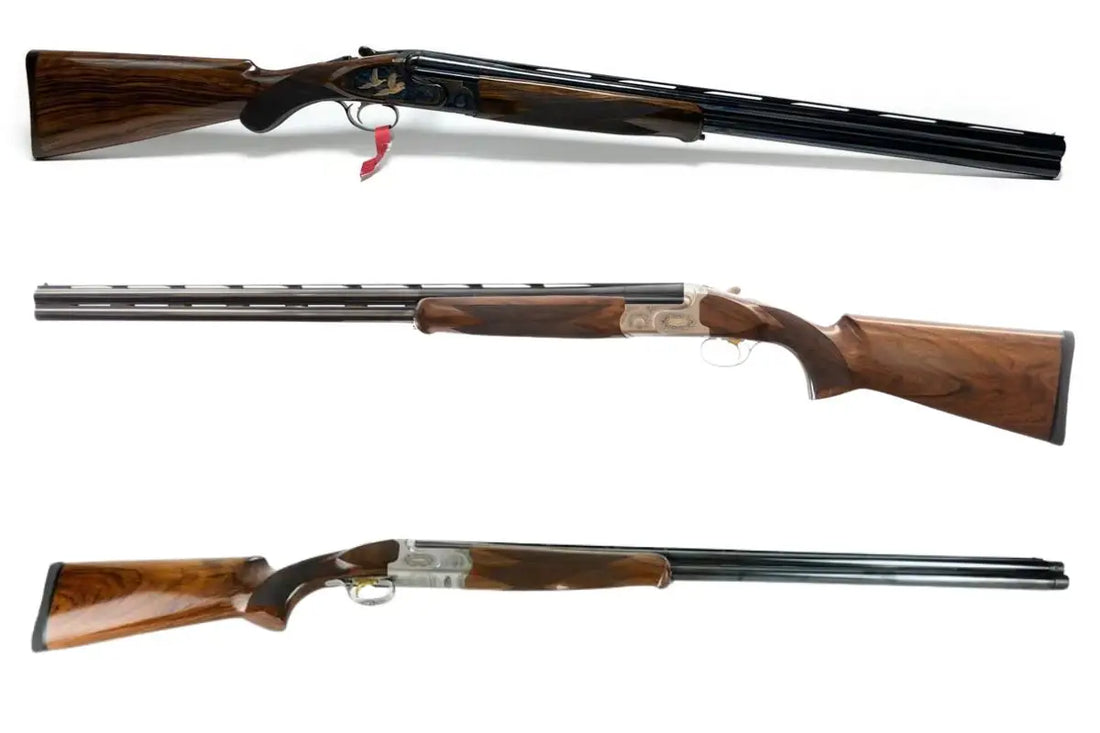
Open any Guerini and you’ll see what makes them feel “alive.” The low‑profile Boss‑style action starts life on five‑axis CNC mills for aerospace tolerances, but every locking surface is then lapped by hand. Barrels are laser‑aligned before soldering to keep points of impact concentric; furniture is cut from Turkish Circassian walnut air‑dried in‑house and hand‑oiled until the grain looks a foot deep.
“Caesar Guerini made its name with customer service and excellent Italian‑made O/Us tailored to the US market,” notes shotgun columnist Phil Bourjaily.
The result is a firearm that balances at the hinge pin, opens like the door on a German luxury sedan, and offers the heirloom appearance normally reserved for five‑figure sidelocks.
2. The Invictus System—A Locking Mechanism Built for 1,000,000 Rounds
Heavy clay schedules punish ordinary doubles, so Guerini re‑engineered the heart of the action. The patented Invictus system moves the locking lug from the bottom of the monobloc to replaceable Invictus Cam recesses in the receiver. When those cams eventually wear, a gunsmith can swap them in minutes, returning headspace to factory spec—no welding or re‑fitting needed.
“The whole system is stronger…creating a gun that is many times more durable than traditional over‑unders,” the company explains in its Invictus IX technical brief.
Durability no longer belongs exclusively to $15,000 competition guns; Guerini brought it to the $6‑9 K class.
3. Perfect Hinge‑Pin Balance Out of the Box
Across the line—from the six‑pound Magnus Light upland gun to the 8‑lb. 10‑oz. Invictus III Sporting—Guerinis share an uncanny balance. Sporting Gun reviewer Mat Manning wrote that the 32‑inch Invictus III “balanced perfectly on the hinge pin even though it has 32″ barrels.”
That neutral fulcrum means the gun starts quickly for tight‑cover grouse yet keeps the muzzles moving on 45‑yard midi crossers. For shooters who like to fine‑tune, the DTS barrel‑weight kit and B‑Fast stock balancer let you shift the center of gravity without a trip to the gunsmith.
4. Recoil That Feels a Gauge Smaller
Italian proof standards already run hotter than SAAMI specs, but Guerini adds lengthened 3″ chambers and five‑inch forcing cones that merge seamlessly into Maxis‑Bore barrels. Couple that with a stock pitched at 14° and a ½‑inch‑wide recoil pad, and even punchy 1⅛‑oz. handicap loads feel more like a 20‑gauge.
Competitive trap veteran Vic Harker praised the Invictus I Trap’s coil‑spring trigger: “No creep, no take‑up, just apply pressure and it was gone.”
Your shoulder—and your scores—will thank you after the 300th target of the day.
5. Stocks That Actually Fit Real Shooters—Including Women
Guerini’s standard dimensions (1½″ × 2¼″ × 14 ¾″) fit a surprising swath of shooters, but every gun can be ordered with a factory tune‑up at the Maryland‑based “Pit Stop.” There, technicians adjust cast, toe‑out, and even trigger reach while you wait. For women, youth, and smaller‑statured hunters, the Syren sub‑brand offers scaled‑down pistol grips, slender forends, and Monte Carlo combs that reduce face slap.
I watched a 5′ 4″ shooter grow her Sporting average from 69 × 100 to 83 × 100 in one season after trading her hand‑me‑down Beretta for a Syren Tempio Sporting—proof that fit isn’t a luxury; it’s a necessity.
6. Competition‑Grade Triggers & User‑Serviceable Fire Control
Unlike many mid‑tier Italian O/Us that rely on leaf springs, Guerini’s proven coil‑spring box brings fast lock times plus field‑swap reliability. The inertia system prevents doubling yet resets even on 7⁄8‑oz. training loads. As Harker noted, the break is “right up there with the best.”
A barrel selector in the safety and an adjustable mechanical trigger on Ascent and Impact models let competitive shooters tailor the pull to any game—Sporting, FITASC, Trap, or Skeet.
7. Laser‑Aligned Barrels & Tunable Point of Impact
Nothing torpedoes confidence quicker than a gun that patterns six inches high or left. Guerini solves the regulation problem by laser‑bore sighting every set of tubes before soldering the ribs. In Shooting Sportsman’s review of the Revenant, “Point of impact was correct, probably thanks to the laser alignment of the barrels during manufacture.”
Add in the DTS adjustable rib on the Summit Impact (50/50 to 120 % high) and you can float a rising trap bird or smoke a driven pheasant with the same gun by simply turning a dial.
8. Gorgeous Aesthetics That Don’t Add Ounces
From the case‑colored Magnus Sporting to the deep‑relief mythological scenes on the limited‑edition Invictus IX GS, Guerini engravings are cut by five‑axis laser then perfected with hand‑chasing. Wood blanks start at Grade 2.5 and climb to Extra Deluxe, yet Guerini hollows buttstocks under the recoil pad to keep weight forward and maintain that celebrated hinge‑pin feel.
9. A Product Line That Mirrors Your Season
Hunters love the Tempio for its 6‑lb. 8‑oz. profile, schnabel forend, and Field & Stream “Best of the Best” pedigree, while Sporting diehards gravitate to the Summit Ascent or Invictus III/IX for raised ribs and 32‑inch barrels. Need a single shotgun for everything? A Summit Sporting with six Maxis chokes will break 25 at Skeet before lunch and drop late‑season roosters before sunset.
As TargetFocused.Life reviewer Kyle Brott puts it, “If you’re a passionate clay shooter, the Summit is absolutely one of the best options out there.”
10. Guerini USA “Pit Stop”—Formula‑1 Service for Shotguns
Buy a Guerini and you’re automatically enrolled in the Pit Stop program: free annual tune‑ups for life (shipping only). Each visit includes ultrasonic cleaning, trigger‑pull verification, top‑lever spring‑tension check, choke inspection, and stock‑finish touch‑up. Need help during a major tournament? Guerini will overnight parts—or even a loaner gun.
As Phil Bourjaily observed, customer service is the brand’s “secret sauce,” and it’s why resale values remain high even after tens of thousands of rounds.
11. Champagne Experience Without a Mortgage Payment
Yes, Guerinis start around $4,500 for a Summit Sporting and climb past $25 K for fully engraved editions, but compare apples to apples: an Invictus III ($8,275 MSRP) delivers a modular locking system, adjustable comb, and DLC‑coated internals—features that cost north of $12 K in many competitors.
“Balanced perfectly, built like a tank, and priced within reach—that’s why you keep seeing them on the podium,” says Olympian and two‑time NSCA National Champion Anthony Matarese Jr. Value plus longevity equals lower cost per broken target—and more birds in the bag.
Choosing Your First (or Next) Caesar Guerini
|
Shooter Profile |
Recommended Model |
Why It Works |
|
Upland Purist |
Tempio 20‑gauge or Magnus Light |
Ultra‑light, game‑style rib, automatic safety, gold‑pheasant engraving |
|
Do‑Everything Generalist |
Summit Sporting 12‑gauge‑30″ |
Versatile ribs, six Maxis chokes, equally at home on clays or pheasants |
|
Tournament Junkie |
Invictus III Ascent or Invictus IX Sporting |
Invictus Cams, higher rib for heads‑up posture, quick‑change POI |
|
Women & Youth |
Syren Tempio Sporting |
Reduced‑pitch pad, shorter LOP, closer grip radius, Monte Carlo comb |
Whatever path you choose, Guerini’s modular choke system and lifetime Pit Stop support future‑proof the investment.
Final Thoughts
Field guns live hard lives among wet cattails; clay guns live even harder ones amid crushed‑rock skeet pads and endless 12‑gauge empties. Caesar Guerini builds doubles that thrive in both worlds, pairing durability with elegance in ways few manufacturers manage.
If you crave effortless mount‑and‑swing dynamics, triggers that break like glass, and after‑sale support measured in decades, step onto the range with a Guerini. Odds are you’ll leave with more Xs on your scorecard—and the contented grin that only a perfectly balanced Italian shotgun can deliver.
Ready to experience a Caesar Guerini for yourself?
Shop current inventory and pricing → Guns.com


