

Lock It & Leave: 11 Expert-Approved Tactics for Securing a Firearm in Your Car
|
# |
Vehicle-Storage Method |
Ideal For |
Headline Pros |
Not-So-Great |
Benchmark Product (MSRP) |
|
1 |
Cabled Lock Box |
Daily carry pistols, rentals |
• <$150 entry cost • Fast removal |
• Relies on thin seat-track metal |
SnapSafe TrekLite XL – $64 |
|
2 |
Inflating “Bridge” Safe |
SUVs & trucks lacking big consoles |
• Wedges solidly between seat & console |
• Limited to sub-compact handguns |
Hornady RAPiD Vehicle Safe – $317 |
|
3 |
Under-Seat Slider Safe |
Full-size pickups & 4Runners |
• Biometric & app control • 18-ga steel |
• Requires 2¼" vertical clearance |
Vaultek VS10i – $239 |
|
4 |
Center-Console Vault |
Factory OEM look |
• 12-ga steel, pry-stop lids |
• Console space sacrificed |
|
|
5 |
Bolt-In Console Insert |
Lease-return friendly installs |
• 10-min DIY, no drilling |
• Key-only lock on base model |
Tuffy Bronco JL/JT insert – $199 |
|
6 |
Rear-Floor Tub Safe |
Crew-cab trucks |
• Hidden under mat • 4-pt lock |
• Slow access |
|
|
7 |
Trunk-Mounted Drawer |
Sedans/coupes on road trips |
• 14-ga steel • 2-handgun + ammo |
• Requires permanent install |
Titan Gun Vault Drawer – $499* |
|
8 |
OEM Glove-Box Safe Package |
Luxury SUVs (Lexus, Cadillac) |
• Warranty-backed fit • RFID valet mode |
• Dealer-only option, $$$ |
Lexus LX600 Safe Pack – $1,200* |
|
9 |
Smart BLE Cable Lock |
“No-safe” rentals & rideshares |
• 110 dB tamper alarm • GPS ping |
• App-pairing learning curve |
Zore-X BLE Cable – $199* |
|
10 |
Layered Car-Alarm & Tint |
Urban street parking |
• Slows smash-n-grab by ~30 s |
• No physical containment |
Llumar 8-mil security film – $8 ft²* |
|
11 |
Insurance & Serial-Log |
Worst-case theft recovery |
• $30 yr add-on covers $2-5 k |
• Paperwork only, not prevention |
USCCA Protector Plan – $30 mo* |
*MSRPs current May 2025.
“A pistol loose in a console is just a free gun for the next smash-n-grab thief. Treat your vehicle like a portable gun safe—or don’t leave a gun in it.”
— Bill Brassard, National Shooting Sports Foundation
1. Why You Must Sweat Vehicle Security
- 51 % of the 112,000 guns reported stolen to the FBI in 2022 came straight out of cars—triple the share a decade ago. One firearm disappears from a vehicle every nine minutes. –ASIS International
- Cities in permit-less-carry states see theft rates up to 18× higher than jurisdictions with mandatory storage laws. –Axios
- Law-enforcement trace data show that stolen car guns re-appear in crimes within 24 months on average. –ATF Part V Theft Report
Bottom line: the moment you step away from your vehicle, the pistol is at greater risk than it ever was on your belt.
2. The Five Core Principles (Memorize These)
- Hard Attach: Cable or bolt the container to chassis metal; seat tracks shear at ≈400 lb of pry force.
- Opaque & Out-of-Sight: Clear top windows invite smash-and-grab. Even biometric LEDs should be taped over.
- Redundancy: Lock the gun and the box and the truck.
- Ammo Separation: In many states, a loaded mag in the same locked box can upgrade a simple infraction to a misdemeanor. Know your code.
- Speed <–> Security Trade: Faster access = thinner doors, more electronics. Choose your compromise before you buy.
3. Detailed Playbook & Product Picks
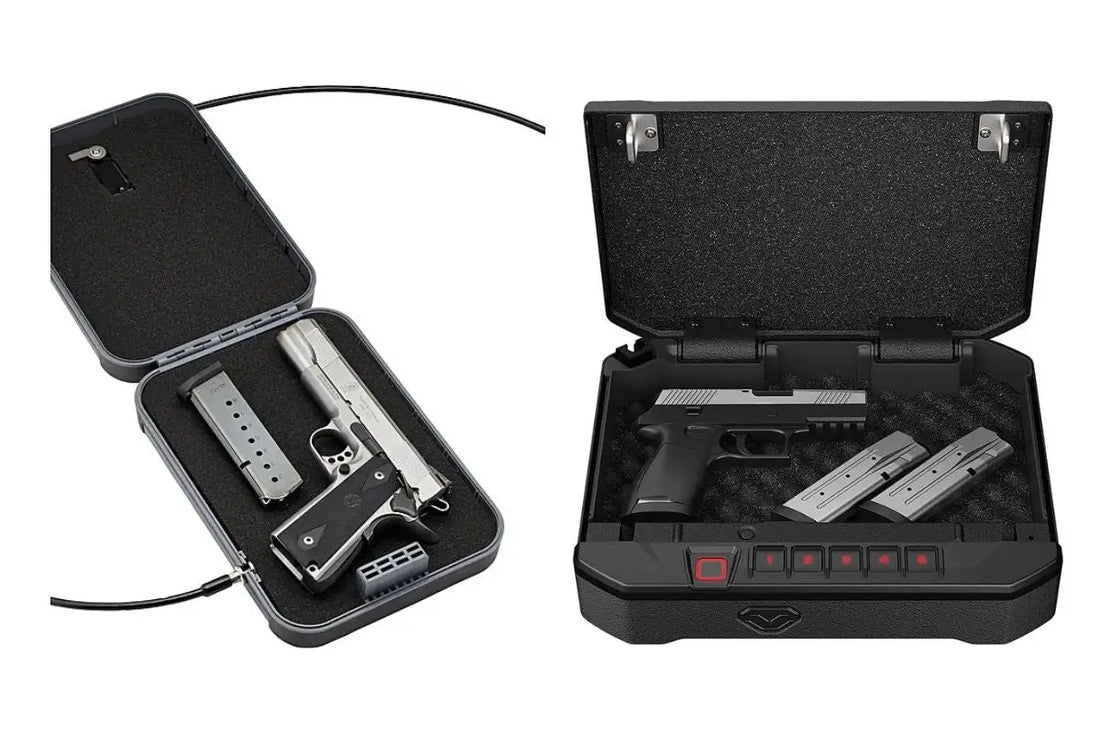
3.1 Cabled Polycarbonate Lock-Box (Budget, Air-Travel Friendly)
Why it works: An FAA-compliant, glass-reinforced poly shell plus 4-digit TSA combo makes the SnapSafe TrekLite XL the go-to for rental cars and glove boxes. Weighs 1.5 lb; 1,500 lb-rated braided cable wraps seat posts.
Pros
- Cheapest legit option (street $55).
- Fits in a backpack when you leave the vehicle.
- Non-marring rubber over-mold—no rattling.
Cons
- ⅛″ poly is cutable with small bolt cutters in ~60 s.
- Key-reset combo can be decoded by reflect-light trick if thief has time.
Upgrade path: Swap to hardened chain (Grade 70, ¼″) + padlock when parking long-term.
3.2 Inflatable “Bridge” Safe (Hornady RAPiD Vehicle Safe)
The RAPiD uses an inflatable bladder to wedge between seat and console—ingenious in cars that lack anchor points. RFID fobs or a touch code pop the spring-assist lid in ≈1 s.
Pros
- True quick-access even while belted in.
- Bladder makes prying almost impossible without deflating.
- Comes with cable for second anchor.
Cons
- Interior height 1.7″—full-size Glock 17 barely clears.
- Needs 12 V power to keep RFID reader alive; unplug for flights.
Pro tip: Leave the car on accessory and practice drawing without flagging your kneecap.
3.3 Smart Under-Seat Slider (Vaultek VS10i)
Vaultek’s 18-ga steel slider safe spits your pistol forward electronically after fingerprint, keypad, or app unlock. Bluetooth logs every entry—handy if you valet park.
Pros
- Best-in-class ~0.5 s biometric wake.
- Internal lithium pack runs 4 months on a charge.
- Anti-impact latch passes California DOJ drop test.
Cons
- Electronics hate –20 °F climates; keep silica packs handy.
- 18-ga still bendable with a 3-ft pry bar—bolt it.
Contrarian take: Mechanical Simplex locks never run out of battery; the VS10i’s speed is meaningless if the cell is dead.
3.4 Console Vault & Tuffy Inserts (OEM-Look Steel)
Console Vault’s triple-guard lid (Ford F-150 ’22-’25) and Tuffy’s Jeep JL insert both use factory bolt holes, so you can return a lease with zero evidence.
Pros
- 12-ga or thicker plate; nearly impossible to pry without 10+ min.
- Retains USB/12 V ports with cut-outs.
- Looks factory; smash-thieves often overlook it.
Cons
- Eats all console space. Wallet and sunglasses need a new home.
- Combo dials are slow under stress unless you pay extra for electronic locks.
Insider quote:
“Fifteen minutes is forever in burglary-time. Make them work that long and they give up.” — Andy Philippi, Founder, Console Vault (industry webinar, Jan 2025).
3.5 Rear-Floor Tub Safes (Lock’er Down LD2048)
Perfect for crew-cab trucks with massive under-floor tubs. The LD2048 uses 12-ga steel, a 4-point lock bar, and counter-balanced lid.
Pros
- Hidden in plain sight under carpet mat.
- 14″ depth swallows a PCC + two mags.
- Install in 10 min, no drilling.
Cons
- Slow draw; you must exit the truck.
- MSRP ≈ $470—pricy.
Make it unbeatable: Add a GPS Tile inside plus a unique UV paint dot on the slide for ID in the recovery room.
3.6 Hard-Mount Drawer in the Trunk
Sedans lack consoles. A shallow steel drawer bolted to trunk bulk-head preserves grocery space yet meets most “locked container” statutes. Choose 14-ga steel, ball-bearing slides, dual cam-locks.
Pros
- Fits a suppressor and loaded mags with a divider.
- Far from cabin—safer with kids.
Cons
- Forget about quick access.
- Permanent install can hurt resale.
Cost curve: DIY steel drawer + Medeco padlock ≈ $250; premium Titan setup ≈ $500*.
3.7 Smart Cable Locks & Alarms
Zore-X BLE cable adds a 110 dB siren if the combo wheel or cable is tampered with and sends GPS pings every 30 s until disabled.
Pros
- No safe required—ideal on trips in states where gun + locked container is legal even if visible.
- Keeps honest thieves honest.
Cons
- False positives inside loud trucks.
- Battery door can break (ver. 1). Wait for June ’25 v2 board.
4. The Legal-Risk Matrix—Know Before You Drive
|
Jurisdiction |
Loaded in Vehicle |
Statute Requires… |
Real-World Penalty |
|
CA |
NO |
Locked container, ammo separate |
Misdemeanor, 6 mo jail |
|
TX (permit-less) |
YES |
“Concealed from ordinary sight” |
Class C if visible |
|
RI (2024 law) |
NO |
Locked container or tamper-resistant lock |
Fine ≤ $1 k + 180 d jail |
Pro advice: Print reciprocity summaries and keep them with your registration; cops rarely know chapter-and-verse storage nuance.
5. Advanced Layering: Your Future-Proof Setup
- Physical Barrier – 12-ga steel or better, bolted.
- Time Delay – Secondary lock (padlock or cable).
- Alarm – Car alarm linked to rear hatch, shock sensor.
- Visibility Dissuader – Ceramic tint (8-mil) delays window punch.
- Digital Breadcrumb – AirTag or Tile in the magwell (works through steel).
- Paper Trail – Serial photographed & logged; add it to renters’ insurance rider.
6. Common Mistakes Even Experienced Shooters Make
- “I’ll only be gone a minute.” Thieves watch gym lots; a smash-n-grab is 15 s.
- Leaving the mount unclipped from the chassis. Cable around seat springs is useless; loop through seat-belt anchor.
- Pistol still loaded. In a collision, inertia can slam the striker forward if the gun is floating inside a cheap box. Unload first.
- Advertising with stickers. A “Molon Labe” decal screams free guns inside.
- Counting on tint alone. Safety film delays but doesn’t deny.
7. Pros & Cons of Smart vs Dumb Locks
|
Smart (RFID/Bio/App) |
Mechanical (Key/Dial/Simplex) |
|
|
Speed |
0.5-1 s once hand trained |
3-5 s dial; 1 s Simplex |
|
Power Dependence |
Battery or 12 V |
None |
|
Defeat Risk |
EMP/power loss, signal spoof |
Code shoulder-surf, lost key |
|
Audit Trail |
Cloud logs |
None |
|
Price Delta |
+30-50 % |
Baseline |
Opinionated call: We run mechanical Simplex in work trucks—zero battery anxiety. In your wife’s Tesla? RFID; the car’s own Li-ion pack keeps it happy.
8. Thinking Ahead—2026+
- Geofenced Safes: Companies like Fort Knox are prototyping containers that auto-lock when GPS strays >20 ft from your phone.
- BLE-to-OBD Integration: Rumors of a safe that won’t open unless the vehicle is in Park with foot on the brake—watch SEMA 2025.
- Blockchain Serial-Proof: Arms-length serial logging on-chain could slash recovery time by proving provenance instantly at pawn shops.
9. Putting It All Together: A Sample Build (2025 F-150)
|
Layer |
Component |
Why |
|
Primary safe |
Console Vault CV-F150-25 |
12-ga, triple-guard, 10-min install. |
|
Secondary tether |
Grade 70 ¼″ chain + Abloy PL362 padlock |
12,000 lb tensile; beats bolt cutters. |
|
Alarm |
Factory Ford Security + tilt sensor |
Detects jacking for catalytic converter. |
|
Window film |
8-mil Llumar Defense |
Adds 45 s pry time. |
|
Tracker |
Tile Pro hidden in magwell |
Cheap breadcrumb. |
Time to breach in field test: ~12 minutes with cordless grinder. Smash-thieves bail in under 2.
10. Frequently Ignored, Highly Useful Extras
- Desiccant packs—prevent rust in sweaty southern summers.
- Spare magazine pouch inside safe; loose mags dent slides.
- Cable management clips so cords don’t advertise safe location.
- Reflectix heat barrier under-seat to keep electronics <122 °F.
- Holster shell inside safe: secures trigger guard during bumps.
11. Final Word
Owning a gun is an exercise in continuous risk-management. The cheapest $60 lock-box beats the bravado of “no one’s going to break into my truck.” Follow the layered approach, respect each state’s statute, and remember: every unlocked gun in a car is just a future crime scene waiting to happen.
Buy the gear mentioned above in one curated bundle → OpticsPlanet.com


