

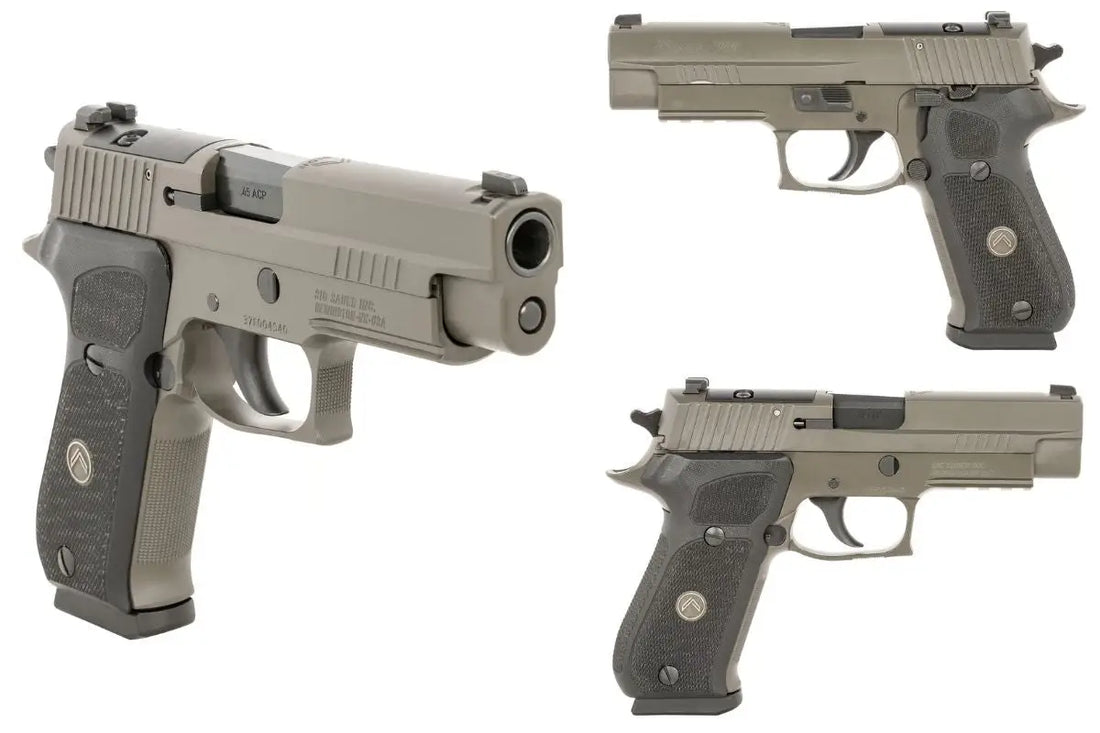
SIG Sauer P220: The 1975 Disruptor That Still Defines Combat-Grade Elegance
|
SIG Sauer P220 at a Glance |
1975 “Wow-Factor” |
2025 Relevance |
|
Action: DA/SA, decocker |
First service pistol to blend double-action safety with single-action precision—no manual safety required, just “decock and holster.” |
Still the reference for hammer-fired ergonomics; short-reset trigger (SRT) kits keep pace with striker pistols. |
|
Frame/Slide: Aluminum alloy / folded carbon-steel (now stainless) |
Cut weight to 30 oz—startling in a .45 ACP era dominated by 39-oz 1911s. |
Modern Nitron-coated stainless slides shrug off +P .45- and 10-mm pressures. |
|
Calibers: .45 ACP (orig.), 9 mm, 7.65 mm, 10 mm, .22 LR |
First European service gun to embrace big-bore .45 ACP in a compact, single-stack format. |
10 mm Legion variant adds 5" barrel, optics-ready slide, X-Ray3 sights. |
|
Controls: Browning-derived lock-up, slide-stop & takedown levers clustered for economy of motion |
Everything falls under the shooting-hand thumb—no gait-breaking safety dance. |
Layout copied verbatim on P226, P229 & U.S. M17; muscle memory still translates. |
|
Accuracy: 1-2 in. @ 25 yd common |
Swiss-German tolerances + inline feed ramp were “bullseye-gun accurate out of the holster.” |
10 mm & SAO Super Match break 2 inches with duty ammo; red-dot plates boost hit probability. |
A Swiss-German Thunderclap (1975)
When the Pistole 75 hit Swiss Army depots, two dogmas died overnight:
- Revolver-style first pull, autopistol firepower. Police brass nervous about “cocked-and-locked” 1911s now had a long, deliberate 11-lb first stroke that mirrored service wheel-guns, followed by a crisp 4-lb single-action—best of both worlds.
- All-steel ≠ mandatory. SIG’s folded-slide construction and aircraft-grade alloy frame saved nearly half a pound without sacrificing durability—a revelation for European soldiers hoofing Alpine passes.
- Fail-safe decocker. A thumb-only lever safely dropped the hammer onto a live chamber with the firing-pin blocked—no trigger press, no white-knuckle ride. Competitors took a decade to replicate the mechanism.
- Inline feed geometry. A nearly straight-line ramp swallowed early JHPs that choked contemporaries like the Beretta 92’s predecessor. Reliability quickly became legend.
“Extraordinarily accurate, very reliable…indeed, one of my all-time favorite handguns.” —Massad Ayoob, Gun Digest review
Engineering Granularity—Why It Worked
- Lock-up & recoil path – Browning tilting barrel, but two robust locking shoulders instead of one: lower slide stress; run hotter NATO +P without peening.
- Folded slide, internal extractor (pre-’94) – Sheet-steel welded, then machined: lighter and self-lubricating phosphate bath. Modern P220R slides are milled stainless, adding mass for 10 mm Auto.
- Barrel fit – In spec guns you’ll measure <0.002" vertical play; that’s Gold-Cup territory in a duty pistol.
- Trigger system – Roller-bearing sear on early Swiss guns provided a glass-rod break; today’s SRT kit (SIG part #220-SRT) delivers a 3.5-mm reset—shorter than most striker designs.
- Maintenance simplicity – Rotate takedown lever 90°, slide lifts forward; no bushings, no barrel links, no pins to drift.
Hard-Data Snapshot
|
Metric |
1975 P220 |
2025 P220 Legion 10 mm |
|
Weight empty |
860 g (30 oz) |
1,133 g (40 oz) |
|
Barrel length |
4.4″ |
5.0″ |
|
Typical group |
1.9″ @ 25 yd, Fed 185 JHP |
2.25″ @ 25 yd, SIG 180 V-Crown |
Evolutionary Branches & Flagship SKUs
|
Variant |
Purpose-Built Edge |
Street Price |
|
P220 R (rail) |
1913-ish accessory slot; Nitron stainless slide |
$999 |
|
P220 Carry (discontinued) |
3.9″ slide on full frame; DA/SA or DAK |
$1,050 (used) |
|
P220 Combat |
FDE anodizing, phosphate-coated internals, threaded barrel for suppressors |
$1,399 |
|
P220 Legion (.45 & 10 mm) |
Gray PVD, X-Ray3 sights, G-10 grips, SRT, optic-ready R2 slide |
$1,599 retail |
|
P220 Super Match SAO |
5″ barrel, adjustable rear, laminated rosewood; single-action only |
$1,749 |
|
Mastershop X-Six II |
Hand-fit, 6″ barrel, polygonal rifling, walnut target grips |
$3,900 |
“Fit and finish are impeccable…one solid gun.” —Josh Wayner, TheTruthAboutGuns 10 mm review
Why the P220 Still Punches Above Its Weight
- Holster Synergy – Same slide profile as P226 means decades of Kydex exist; duty rigs are never unicorns.
- Magazine Compatibility – All .45 ACP full-size mags interchange from 1976 to today; 10 mm sticks are caliber-unique but identical dimensionally—load rigs once, run two calibers.
- Trigger Discipline Trainer – DA first pull forces shooters to master prep and press; transition to striker guns feels effortless after P220 reps.
- Recoil Intelligence – Narrow single-stack grip sits lower than double-stack .45s (e.g., Glock 21), putting bore axis closer to the wrist and taming muzzle flip.
- Modern Modularity – Legion slide is milled for Romeo1 Pro/DeltaPoint-Pro footprint, something many polymer “classics” still lack.
- Aftermarket Ecosystem – Grayguns SRT, Keres offset triggers, Wilson Combat steel guide-rods—all drop-in.
Pros vs. Cons (frankly)
|
👍🏼 Pros |
👎🏼 Cons |
|
Match-grade accuracy out of the box |
Single-stack = 8-rd capacity (.45) or 10 rd (10 mm extended) |
|
Bomb-proof alloy frame survives 50k-round torture tests |
Proprietary rail on earlier P220R limits some light/laser fits |
|
DA/SA + decocker = safest hammer pistol to reholster |
Heavy DA stroke (≈11 lb) punishes poor technique |
|
Decades-long parts interchange; zero obsolescence |
10 mm variant requires Popeye forearms to rack slide |
|
Optics-ready Legion & R2 lines future-proof the platform |
Pricey—German craftsmanship comes at a premium |
Collector & Investment Angle
West-German-marked, folded-slide “KH” and “KG” proof-code guns fetch $1,400-1,600 in VG+ condition; add $300 if the heel-release mag catch is intact. Early Swiss P75 military contracts with gray phosphate slides are unicorns—expect $3k-plus. Meanwhile, new Legion runs hold value stubbornly (15 % drop vs. 25-30 % on polymer peers) thanks to SIG’s tight distribution controls and the swagger of Legion-only training events.
Verdict
Fifty years on, the P220 remains the connoisseur’s working gun—precision of a target 1911, simplicity of a service revolver, and the reliability culture that gave birth to the P226 Navy SEALs carried into Iraq. If you prize engineering elegance over raw capacity, the P220 is still the yardstick by which all big-bore combat pistols are measured.
Shop for your own Sig Sauer P220 at Guns.com.


