

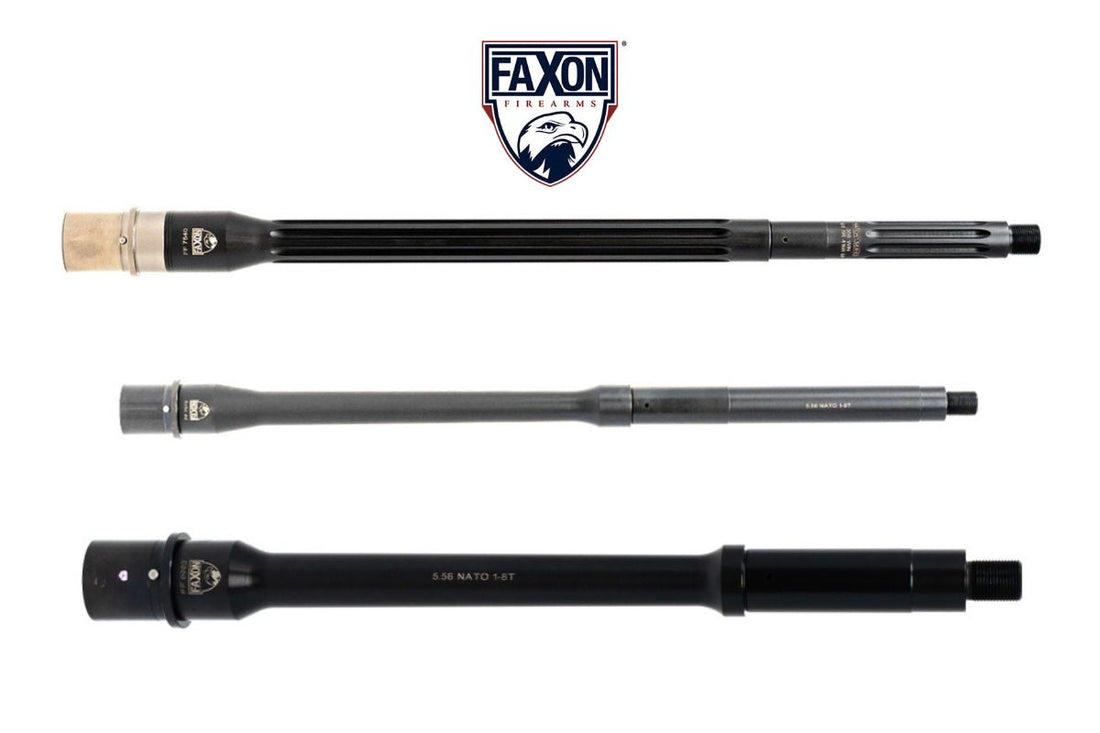
Chrome-Lined vs. Stainless Steel AR-15 Barrels: Which Should You Choose?
Choosing between a stainless steel and a chrome-lined barrel for your AR-15 is more than a matter of taste—it's about mission, performance, longevity, and budget. While both materials are tried-and-true in the firearms world, each has clear advantages depending on your priorities.
In this deep-dive guide, we'll break down the technical differences, real-world performance, industry recommendations, and product examples—helping you make the best decision for your build.
“A rifle is only as good as its barrel. That’s where accuracy starts and longevity is tested.”
— Nathan Schueth, Director of Product Management at Faxon Firearms
🔍 TL;DR for Skimmers
- Go stainless if you’re building a DMR, SPR, or want sub-MOA accuracy for target shooting or hunting.
- Go chrome-lined if your AR-15 will see hard use, high round counts, or rough environmental conditions.
- Stainless wears faster but shoots tighter groups. Chrome-lined is battle-proven, easier to maintain, and lasts longer.
💡 What Actually Is Chrome-Lining and Stainless Steel?
🔩 Chrome-Lined Barrels
- Material: Usually made from 4150 CMV (chrome-moly vanadium) steel.
- Process: An interior coating of hard chrome (~0.001"–0.002") is applied to the bore and chamber.
- Why it matters: The chrome layer is extremely hard and corrosion-resistant. This is the gold standard for military rifles around the world (e.g., M4, AK-47).
Pros:
- Dramatic increase in barrel life.
- Easier cleaning, especially when running steel-case or dirty ammo.
- Heat resistance for sustained fire (like mag dumps or high-tempo drills).
- Less fouling in gas systems.
Cons:
- Slight loss in accuracy due to uneven chrome thickness (though modern tech has improved this).
- Slightly more expensive than non-lined steel options.
- Not ideal for precision-focused shooters.
⚙️ Stainless Steel Barrels
- Material: Most commonly 416R stainless steel—a machinable, corrosion-resistant alloy.
- Why it matters: Stainless is softer and easier to machine with ultra-tight tolerances, ideal for match barrels.
Pros:
- Exceptional accuracy—commonly 0.75–1.0 MOA with match ammo.
- Great corrosion resistance (though not as high as chrome-lined).
- Better temperature stability for short- to mid-length shooting sessions.
- The best option for DMR and SPR builds.
Cons:
- Wears faster under high round counts and heat.
- Susceptible to throat erosion with prolonged rapid fire.
- Typically heavier than chrome-lined counterparts.
- May cost more in high-end configurations.
⚔️ Use Case Scenarios: Which Should You Choose?
🧠 Scenario 1: You’re Building a DMR or SPR
Go Stainless.
You want the highest possible accuracy, especially at distances beyond 300 yards. Pair a Faxon 18” Match Series Fluted 416R Barrel with a 1:8 twist for outstanding results with 69–77gr bullets.
“Precision barrels are all about consistency and harmonics. Stainless gives us control.”
— John Paul, JP Enterprises
Suggested Barrel:
🔗 Faxon Match Series 18″ Heavy Fluted 416R Barrel
🛡️ Scenario 2: You Want a Hard-Use Carbine for Self-Defense or SHTF
Go Chrome-Lined.
Chrome-lined barrels excel in heat, mud, neglect, and volume shooting. If you’re prepping for the worst or just want something bombproof, this is your best choice.
Suggested Barrel:
🔗 Faxon 16″ Government Profile Chrome-Lined Barrel
Bonus: This barrel is cold hammer-forged, a process that further enhances strength and longevity.
🎯 Scenario 3: You’re a Weekend Warrior Doing Mid-Range Steel Shooting
Leaning Stainless.
If your priority is accuracy for drills at 100–400 yards but you’re not worried about high-volume mag dumps, stainless steel offers better results. Match it with an adjustable gas block for even smoother performance.
🔫 Scenario 4: You’re Building a Do-It-All General-Purpose Rifle
Toss-Up: Chrome-Lined or Nitride CMV.
For most users, chrome-lined or nitrided 4150 CMV offers enough accuracy (1–2 MOA) and incredible longevity. It won’t rust, it’s low-maintenance, and the groups are still tight enough for 95% of users.
Great GP Option:
🔗 Faxon 16” Gunner Profile, Chrome-Lined, 4150 CMV
🧬 Performance Breakdown: The Technicals
🎯 Accuracy
- Stainless: Typically 0.5–1.0 MOA with match ammo.
- Chrome-lined: Usually 1.5–2.0 MOA, though some hammer-forged examples approach 1.0 MOA.
- Important: Barrel profile, twist rate, and ammo quality matter as much as barrel type.
🔥 Barrel Life
- Chrome-lined: 15,000–20,000+ rounds is common before major accuracy drop.
- Stainless: Typically 6,000–8,000 rounds in precision use; throat erosion sets in earlier.
Why? Chrome-lining is about 3x harder than stainless, so it resists gas cutting and thermal fatigue far better.
💨 Heat Management
- Stainless gets hotter faster, affecting point-of-impact (POI) shift.
- Chrome-lined barrels, especially government or SOCOM profiles, resist heat-related degradation better.
🧼 Maintenance
- Chrome-lined barrels clean easier.
- Stainless needs a little more attention if you're running dirty ammo (like Wolf or TulAmmo).
🔍 The Evolution of Chrome Lining: Not Just for Milspec Anymore
In the past, chrome-lining had a deserved reputation for degrading accuracy. But modern techniques—especially those used by Faxon Firearms, Daniel Defense, and FN Herstal—apply chrome extremely evenly.
“Our chrome-lined barrels routinely shoot under 1.25 MOA with good ammo. That’s more than enough for defensive or duty use.”
— Faxon Firearms Engineering Team
🔄 What About Nitride or Melonite Barrels?
- Salt Bath Nitriding (aka QPQ or Melonite): Offers a hard surface finish (up to 70 Rockwell) and corrosion resistance similar to chrome.
- Pros: Lower cost, decent accuracy (1–1.5 MOA), very durable.
- Cons: Still not quite as durable or heat-resistant as chrome-lining for extreme use.
- Best for: Budget-minded general-purpose builds.
Example:
🔗 Faxon 16” Gunner 5.56 NATO Mid-Length 4150 QPQ Nitride
🏆 Our Barrel Picks by Category
|
Use Case |
Recommended Barrel |
|
Precision / DMR |
Faxon Match Series 18″ 416R Fluted |
|
SHTF / Duty / Defense |
Faxon 16″ Govt Profile Chrome-Lined |
|
General Purpose |
Faxon 16″ Gunner QPQ Nitride |
|
Lightweight / Range Toy |
Faxon 14.5″ Pencil Nitride |
🧠 Expert Recommendations
|
Expert |
Quote |
|
Chuck Pressburg |
"Chrome-lined barrels are for fighting. Stainless is for scoring hits at distance. Choose your fight." |
|
John Hollister |
"Stainless steel gives you unmatched precision, but don’t expect it to live forever." |
|
Ian McCollum |
"If you’re not running tens of thousands of rounds, you won’t notice the chrome accuracy trade-off." |
🧨 Final Verdict: Chrome-Lined vs. Stainless Steel for Your AR-15
- Stainless steel barrels are the clear choice for those who prioritize precision, tighter groupings, and range performance—especially in DMR or hunting roles. But they’re not built for sustained abuse.
- Chrome-lined barrels offer unmatched durability, heat resistance, and longevity, especially in harsh environments or high-volume roles. Ideal for duty guns, go-bags, and SHTF builds.
Our recommendation:
For 90% of users, a chrome-lined or nitrided CMV barrel is the best balance of cost, longevity, and performance.
But if you shoot for groups or compete, go stainless and don’t look back.
🔗 Buy Your AR-15 Barrel Now
Choose from the best AR-15 barrels from Faxon Firearms at FaxonFirearms.com.


